Writing from the perspective of the Federation and interwar years, James Chester Draper recounts the arduous realities of agricultural life and livestock management across the Arthurs Creek, Glenburn, and King Parrot Creek districts. These reminiscences detail the constant environmental challenges faced by pioneer families such as the Drapers, the McKenzies, and their neighbors, who navigated the perennial threats of devastating bushfires and dangerous floodwaters while maintaining their rural livelihoods.
We used to take the horses to Cockerell’s[1] at Mernda to be shod. The gravel roads wore out the shoes very quickly. By watching the blacksmith, I learned how to do our own[2], and I kept quite a lot of horses shod, including riding horses.
In the summer my father would keep a lookout for bush fires, and on at least two occasions he spotted a fire in the Board (the Yan Yean Reservoir ground) over near Castle Hill. He sent Tom to call in the Bassett family and the Reid family, and he and I attacked the fire. We used the cart track on Cade’s Lane and burnt back. Cade’s Lane at that time continued from Yan Yean to Walk’s Hill on Ridge Road. We had our own fire on several occasions when trees were hit by lightning. Worst of all was a fire about 1914, when our shed and stable were burnt, and we lost the wagon and other implements. The wagon was replaced with a lorry, which was a poor substitute.
In 1926, when most of Victoria was burnt in bush fires, I went to 'Glenburn'. The bush was on fire all the way and at Glenburn I joined Mick Coonan and Eff McKenzie fighting the fire along the Boggy Creek. We were at it for two weeks. Fires were quite common in dry summers. On one occasion, Staff[3] was camped with me at Glenburn. A north wind was blowing, and we had not noticed smoke to the south. We were on our way to Uncle Charlie McKenzie’s[4] for our bread, which he would bring from Yea on a Friday.
About a mile away we came to the fire burning slowly against the wind, but a few minutes later the wind changed to the south. We galloped ahead of it, back to our hut as the fire got there. I put a wet towel over Staff’s head and held the two horses in the doorway. The fire soon passed. One horse had its tail burnt off and our stockyards were burnt to cinder. The fire left us with a couple of miles of fencing to be done, as well as rebuilding the yards.
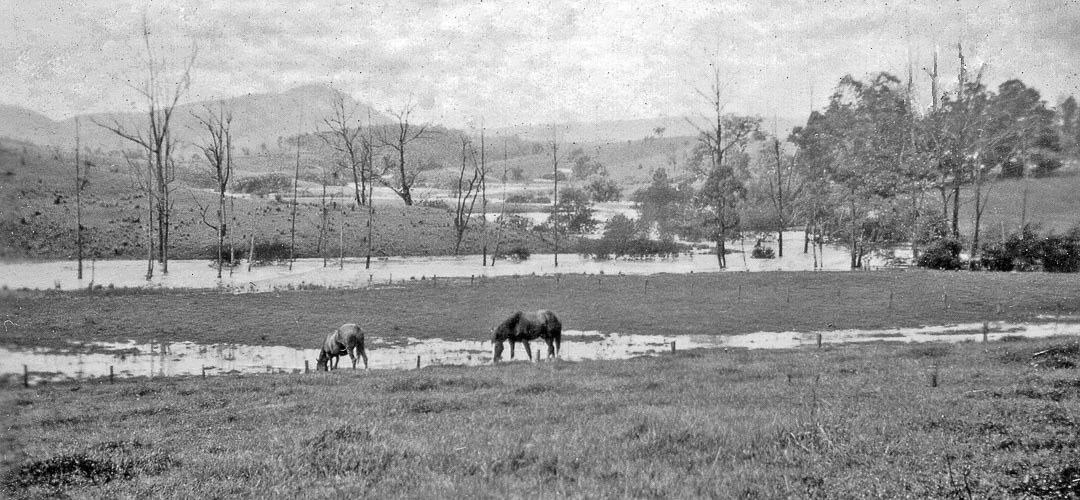
It was not all fires. We had a share of floods as well. One night coming back from Uncle Charlie’s, the horse Staff was on would not cross a flooded creek. I pushed him in. He was on his back with feet in the air, head under water. I tried to pull him up by the bridle. It broke. I got under him in the water and up ended him. Sometimes we would arrive at Boggy Creek with cattle - usually about eighty - and find it in flood. It was very hard to force the cattle into the flood and if it was strong, they were washed downstream. Somehow, we would eventually get them out on the correct side, only to have a repeat when we came to Rocky Creek. The rabbit dogs were always a help, forcing the cattle into the flood. We had twenty-six rabbit dogs. They chased the rabbits into the burrows from the ferns. We then dug out the burrows, killing dozens of rabbits.
One day I was alone with a mob of cattle travelling via Flowerdale when, at Horseshoe Bend near Happy Valley, a bullock fell down a bank into the flooded King Parrot Creek. He settled with his front feet on a stump in the water. I swam the pony across the creek, tied my stock whip to its horns and on to the pony’s tail and towed him to shallow water, where the whip broke. I got the bullock a year later, quite fat, and sold it for thirteen pounds.
Another time, Tom and I went via a track called Dead Horse Hill, where the S.E.C. line runs today. Tom had the cart. A big storm came up. We camped with the cart. My mob of cattle disappeared. Next morning, we found most of the cattle down at the Glenburn Road. We were nine short. A fortnight later I found these. They had crossed the Island Creek and found a grassy flat. They were well fed and had put on condition.
It was very wet at 'Glenburn', and on one occasion we had run out of food. We tried to get out, but the Rocky Creek was much too high. We camped, but next day thought we’d try to get out again. We had two horses in the dray. The leader swam well, and the horse in the sharves and dray followed. The water swirled around me as I sat on the side of the dray. It was probably the weight of the dray that saved us. The next stop was home.
[1] Cockerell’s Forge, on the corner of Plenty Road and Bridge Inn Road, Mernda, was built in the 1850s for John Cockerell with assistance from his brother-in-law, Moses Thomas.
[2] In later years this skill would help to save a man’s life, when Jim had been able to shoe four horses rapidly, thereby enabling a rescue party to quickly find an injured cattleman in the high country in 1944 .
[3] ‘Staff’ was Leslie Stafford Draper (1909 – 1992), Jim’s younger brother.
[4] ‘Uncle Charlie McKenzie’ was Charles Hugh McKenzie (1862 – 1943), the husband of Elizabeth Hurrey (1872 – 1937) who was the sister of Jim’s mother, Blanche Draper (nee Hurrey, 1880 – 1968).