Documenting the transition from horse-drawn transport to early motorization, these reminiscences by James Chester Draper offer a vivid portrait of agrarian life in the Arthurs Creek, Streamville, and Whittlesea districts during the First World War and its immediate aftermath. The narrative details the challenges of orchard management, the reliance on itinerant labour for seasonal harvesting, and the social impact of the 1918-1919 influenza pandemic on local clergy and community institutions.
The first motor car in our area was owned by Denny Murphy at Streamville. McPhee’s Hill on Deep Creek Road gave him a lot of trouble. When it was a bit wet, he would get part way up, then back down and take a run at it. After many tries, he would come to our place to get a horse to pull him up the hill. 'Barton Hill' did not have any motor vehicle before the 1930s.
Streamville was the home of Jim, Pat and Denny Murphy. Jim, Pat and Denny had families and a school was built. Other pupils were Lodge’s, Bill Brennan’s, Edge’s, Lobb’s and Underwood’s.
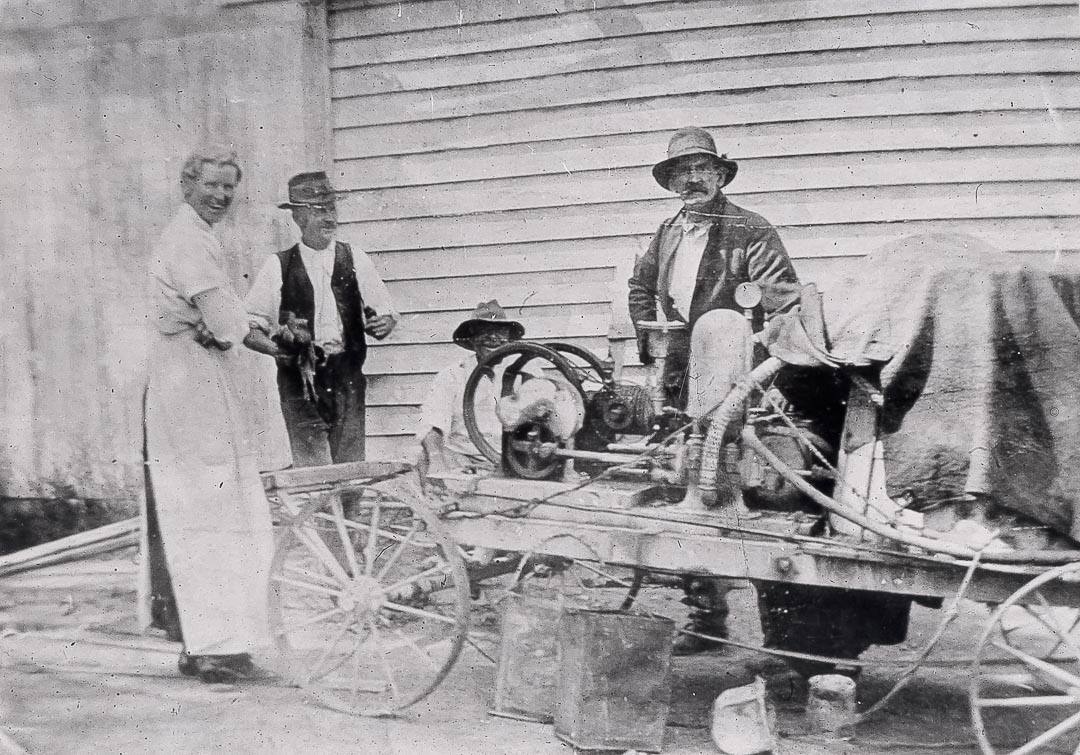
One of the problems with growing apples and pears was the Codling moth grub[1], and we spent a lot of time spraying the crop. Our first motor pump was a one horse-power ‘Tom Thumb”. This was lost in the fire when the wagon was burnt. We later had a bigger motor pump. We used to pick up the windfall apples into bags, and cart them out for the cattle and horses. We grew our own fruit trees. Plums and apricots were budded or grafted to cherry plum cuttings, and apples and pears to suckers from the old trees. Peaches were budded on to seedlings.
Until the motor vehicle came, Melbourne was supplied with everything from the surrounding districts. Thousands of horses were used in Melbourne for delivery, and chaff, hay and oats were carted in to feed them. Firewood was carted daily, as well as milk from the dairy farms.
We grew hay and the travelling thresher would call and thresh the oats out for horse feed. These threshers would have about sixteen men and were driven by a steam engine. The steam engine would arrive pulling a number of vehicles -–a cabin, the thresher, water cart, elevator and a few more vehicles. The farmer supplied meals, and the men would try to get to a good food farm for the weekend. There were also travelling chaff cutters. The chaff and oats were carted to Yan Yean Railway Station and trucked to Melbourne.
The first tractor we saw belonged to Cr. L.W. Clarke, who lived in Chapel Lane, Doreen. It was during the war and of course had steel spike tyres. Cr. Clarke also had land at Yan Yean. Our other councillors were Cr. William Reid of Hazel Glen, Cr. Pat Murphy of Streamville and Cr. Louis Brock of Nutfield.
Our Uncle Tom Hurrey persuaded our parents to send us to Sunday School at Mernda Methodist Church. It was 1916 and very difficult at that time on account of a shortage of horses[2]. Later when we got ponies, we rode to the Church of England at Whittlesea and to Hazel Glen. At that time there was a Church of England at Hazel Glen on the north-east corner of the Bassett property at Bannon’s Lane. The vicar at Whittlesea was Reverend James. He was rejected from the Army with a bad heart. He said he would give his job to a returned digger. He took the Scout Troop.
Each of the Scouts tried to own or borrow a horse. Tom and I were not allowed to go on account of the distance. Jack McKenzie was in Scouts and his father had a foal in the paddock. We caught it and led it with Jack on it, and got on O.K. for a time or two, but Jack got impatient and saddled up on his own and got on board. The foal galloped up the lane, crossed the Arthur’s Creek Road and went through a tall acacia hedge and four-rail fence before turning a somersault. No one was hurt and Uncle Tom Hurrey and Mr. McKenzie finished breaking in the horse. When the war ended, Rev. James handed over Whittlesea to Rev. Len Croker. Mr. James went as Chaplain to the Alfred Hospital where he caught influenza and died. Hundreds died in the pandemic[3].
[1] Codling moth, Cydia pomonella (L.), is the principal insect pest of pome fruit in Victoria. The larvae (caterpillars) need to feed on fruit to survive to maturity. They are highly dependent on fruits as a food source and thus have a significant impact on crops. If not controlled almost the entire crop can be affected.
[2] Every fighting force in the First World War experienced a shortage of animals. Horses and mules were the basic power sources for nearly all vehicles in the war, including pulling guns and supply wagons. The German defeat was in some part related to their running out of animal power. For example, during the twenty months that the U.S. was involved in the war, 243,360 animals (horses and mules) were procured from the US, France, England and Spain for the Allied Expeditionary Force. An unsuccessful search for animals extended, in the summer of 1918, to Portugal and Morocco.
[3] Six months before the Armistice ended the First World War a new and deadly disease was unleashed on the world. Popularly known as ‘Spanish’ flu it killed twenty million people within twelve months. Australia remained free of infection for some of that time, but by the end of 1919 all Australian states shared a death toll of 12,000 people.